Beyond Intelligence: Why Context Is the Foundation of Successful Agentic AI
Understanding how context engineering drives smarter decisions, greater autonomy, enterprise trust, and business value in the age of Agentic AI.
The mAIcroSpace team12 min read
Introduction: Intelligence without context is not enough
The rapid evolution of Artificial Intelligence is moving us beyond conversational assistants and traditional generative AI applications toward a new generation of intelligent, autonomous systems: Agentic AI.
Unlike conventional AI applications that primarily respond to user instructions, Agentic AI systems can understand objectives, plan activities, make decisions, interact with enterprise systems, execute tasks, and adapt their behavior based on changing circumstances.
This represents a significant shift in how organizations can leverage AI.
However, as organizations begin implementing Agentic AI, an important architectural consideration is emerging: intelligence alone does not make an AI agent effective. Context does.
An AI agent may have access to a sophisticated Large Language Model (LLM), powerful reasoning capabilities, and an extensive collection of tools and APIs. Yet, without the appropriate context, it may make decisions that are technically plausible but operationally incorrect, commercially inappropriate, or inconsistent with organizational objectives.
Consider an AI agent responsible for managing procurement activities. Knowing how to compare supplier prices is useful, but making an effective purchasing decision requires much more. The agent needs to understand inventory levels, supplier relationships, contractual obligations, delivery requirements, organizational policies, budget constraints, and business priorities.
It is the combination of intelligence and context that enables the agent to make meaningful decisions.
As organizations transition from AI experimentation to enterprise-scale Agentic AI implementation, context must become a first-class consideration in AI architecture and governance.
1. Understanding context in Agentic AI
Context in Agentic AI refers to the information an agent uses to understand its environment, interpret instructions, make decisions, and determine the appropriate actions to achieve its objectives.
It extends well beyond the immediate prompt or user instruction.
An effective context framework may incorporate several dimensions:
- User context: information about the user, their role, preferences, permissions, and previous interactions.
- Business context: organizational objectives, business policies, operational processes, commercial agreements, and regulatory requirements.
- Task context: the agent's current objectives, previous activities, decisions, dependencies, and outstanding actions.
- Environmental context: real-time information from enterprise applications, external systems, APIs, and changing operational conditions.
- Historical context: previous interactions, outcomes, decisions, and relevant experiences retained through memory.
- Domain context: industry knowledge, specialized terminology, subject matter expertise, and domain-specific rules.
- Technical context: available tools, APIs, application capabilities, system dependencies, and integration constraints.
The ability to combine these dimensions allows an agent to move beyond simply responding to instructions and toward understanding the broader environment in which it operates.
2. Why context matters: from reactive AI to intelligent agency
Traditional generative AI applications are often designed around a question-and-answer interaction model. A user asks a question, the model processes the prompt, and a response is generated.
Agentic AI introduces a more complex operating model. Agents must understand objectives, maintain state, plan multiple activities, interact with external systems, evaluate outcomes, and potentially repeat the process until a goal is achieved.
This introduces a fundamental dependency on context. Context enables an agent to understand:
- What needs to be accomplished.
- Why the task is important.
- What information is available.
- What has already happened.
- What constraints must be respected.
- Which actions are appropriate.
- Whether an outcome has been successfully achieved.
Without this understanding, an agent risks operating as an intelligent but disconnected system. With context, it can become an effective participant in business processes.
3. The business benefits of context-aware Agentic AI
Context is not simply a technical consideration. It has direct implications for business value.
Better decision-making
Context allows agents to evaluate decisions using relevant business information rather than isolated instructions.
For example, a procurement agent can evaluate supplier pricing alongside contractual commitments, delivery performance, inventory requirements, and approved supplier policies. The resulting recommendation is more likely to reflect actual business priorities.
Greater accuracy and relevance
Access to authoritative enterprise knowledge and domain-specific information helps agents generate more relevant responses and reduces the risk of unsupported assumptions.
This is particularly important in regulated industries and operational environments where inaccurate decisions can have financial or compliance consequences.
Improved personalization
Context enables agents to understand individual users, customers, and business scenarios. Rather than treating every interaction independently, agents can use appropriate historical information and preferences to deliver more meaningful experiences.
Continuity across complex workflows
Agentic AI frequently involves multi-step activities that extend beyond a single interaction. Context allows agents to retain awareness of completed activities, outstanding tasks, previous decisions, and workflow dependencies. This improves continuity and reduces unnecessary repetition.
Increased operational efficiency
When agents understand organizational processes and have access to relevant enterprise information, they can make better use of available tools and resources. This creates opportunities to reduce manual intervention, eliminate duplicated activities, accelerate workflows, and improve productivity.
More effective multi-agent collaboration
In multi-agent architectures, context becomes even more important. Research agents, planning agents, execution agents, and validation agents must exchange relevant information to achieve shared objectives. Effective context sharing reduces fragmentation and enables specialized agents to collaborate more consistently.
4. The risks: when context becomes a liability
While context can significantly improve agent performance, poorly managed context introduces new risks.
The objective should not be to give agents access to everything. It should be to give them access to the right information, at the right time, with appropriate controls.
Some of the most important challenges include:
Context overload
More context does not necessarily produce better decisions. Excessive information can bury important instructions, introduce irrelevant details, increase token consumption, and negatively affect reasoning quality. This makes context selection and prioritization critical.
Incorrect or outdated information
Agents may make inappropriate decisions when relying on outdated policies, incomplete records, or inconsistent enterprise data. Maintaining authoritative and current information sources is therefore essential.
Context poisoning and prompt injection
External documents, websites, knowledge repositories, and other untrusted sources may contain malicious instructions or misleading information. If an agent treats untrusted content as authoritative instructions, it could behave inappropriately or take unintended actions.
Clear separation between trusted instructions and untrusted data is fundamental to secure agent design.
Privacy and security exposure
Context can contain sensitive customer information, employee records, financial data, intellectual property, and confidential business information. Agents must operate within appropriate identity, authorization, and data access boundaries.
An agent should never receive unrestricted access simply because its underlying service account has broad system permissions.
Context fragmentation
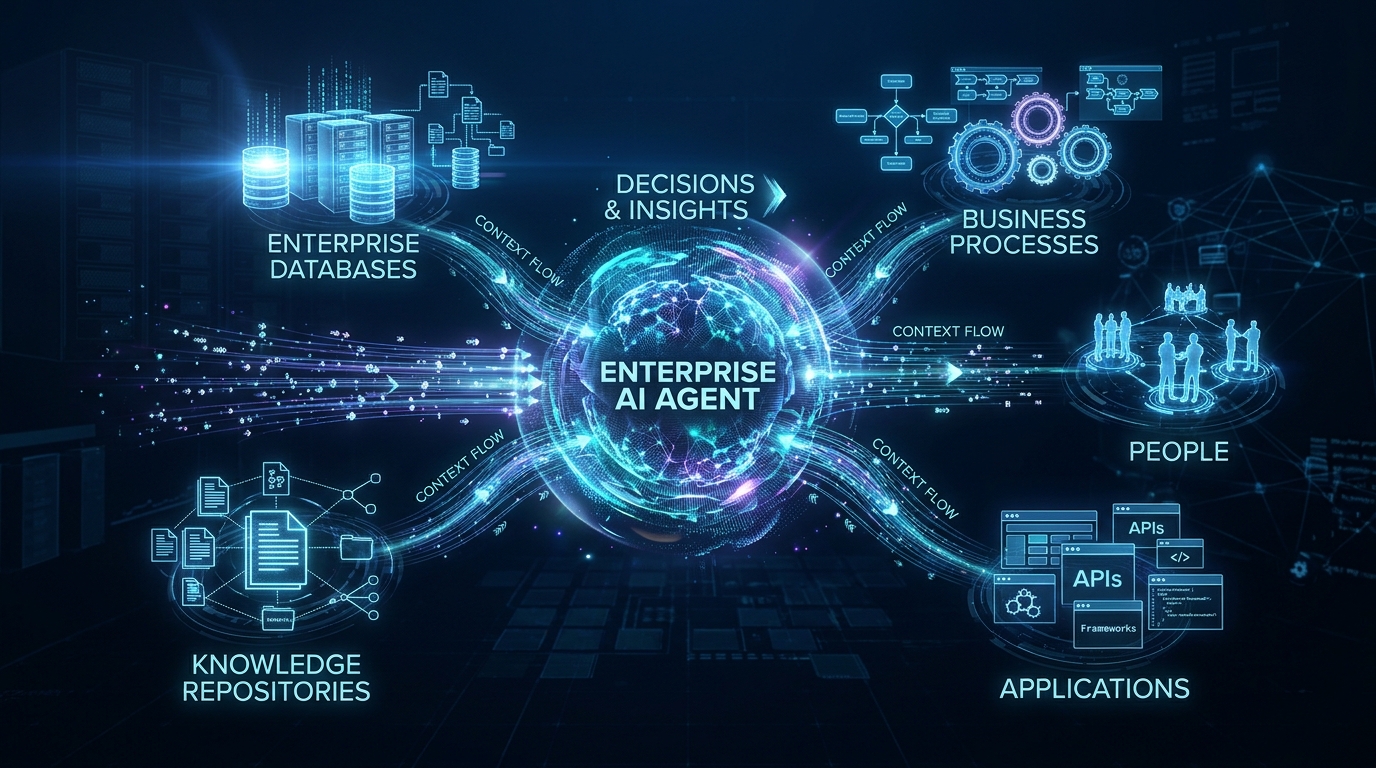
Enterprise information is distributed across CRM, ERP, HR, finance, document repositories, APIs, and other operational systems. If an agent can access only a subset of these systems, it may develop an incomplete understanding of a business situation. Integration and information orchestration become important architectural considerations.
Uncontrolled memory
Agents that retain information across interactions may inadvertently preserve incorrect assumptions, outdated preferences, or information that should not be reused. Memory requires appropriate validation, retention, and deletion policies.
Cost and performance
Large context windows, repeated retrieval operations, and excessive memory can increase inference costs and response times. Context engineering must therefore balance completeness, relevance, accuracy, performance, and cost.
5. Context engineering: the emerging discipline
One of the most important developments in Agentic AI implementation is the emergence of context engineering.
Prompt engineering focuses primarily on designing instructions that guide an LLM. Context engineering takes a broader architectural perspective. It addresses how information is sourced, retrieved, filtered, prioritized, structured, retained, shared, and validated throughout an agent's lifecycle.
It involves answering several important questions:
- What information does an agent actually need?
- Which systems and repositories provide that information?
- How can the agent determine whether information is authoritative?
- When should information be retrieved?
- How should historical information be retained?
- How should context be transferred between agents?
- How can conflicting information be resolved?
- What information should an agent be authorized to access?
In essence, context engineering ensures that an agent has the right information, in the right format, at the right time, with the appropriate level of trust.
This is a significant evolution from simply designing better prompts.
6. Building a context-aware Agentic AI architecture
For enterprise implementations, context should be designed as an integral architectural capability rather than treated as an afterthought. A practical architecture can be considered across five layers.
Layer 1: Context sources
This layer provides the information an agent needs. Typical sources include enterprise applications, databases, APIs, document repositories, knowledge bases, external data providers, and user interactions.
The objective is to establish access to relevant business and operational information.
Layer 2: Context retrieval and orchestration
This layer determines which information is relevant to the current task. Technologies such as Retrieval-Augmented Generation (RAG), semantic search, metadata filtering, and API-based retrieval can help agents access relevant information dynamically.
The retrieval process should also consider data freshness, provenance, reliability, and user permissions.
Layer 3: Context and memory management
This layer manages the information required throughout an agent's lifecycle. It may incorporate:
- Working memory for the current task.
- Episodic memory for previous interactions and experiences.
- Semantic memory for established knowledge and facts.
- Procedural memory for workflows and instructions.
The architecture must determine what information is retained, how it is updated, and when it should be discarded.
Layer 4: Agent reasoning and execution
This is where the LLM and agent framework use the assembled context to interpret objectives, plan activities, select tools, and execute actions.
The agent should operate within clearly defined permissions and business constraints.
Layer 5: Feedback, monitoring, and governance
The final layer evaluates agent performance and updates the relevant context. It includes outcome validation, audit trails, human approvals, memory updates, security monitoring, and continuous improvement.
Importantly, context management is a continuous lifecycle rather than a one-time activity.
7. Context in multi-agent systems
The importance of context increases significantly when organizations adopt multi-agent architectures. In these environments, different agents are assigned specialized responsibilities.
For example, consider a customer onboarding process involving:
- A Customer Research Agent.
- A Compliance Verification Agent.
- A Risk Assessment Agent.
- An Onboarding Execution Agent.
- A Quality Assurance Agent.
Each agent needs a different view of the customer and the onboarding process. The research agent may gather customer information, while the compliance agent verifies regulatory requirements. The risk assessment agent evaluates potential exposure, and the execution agent coordinates the onboarding workflow.
For this architecture to work effectively, agents must exchange relevant context. However, sharing all available information with every agent is neither necessary nor desirable.
A well-designed architecture should define standardized handoff structures, including relevant findings, supporting evidence, confidence levels, outstanding questions, and task status.
This improves collaboration while maintaining appropriate information boundaries.
8. Context governance: the foundation of trust
As agents become increasingly autonomous, organizations must recognize that context governance is closely connected to AI governance.
A context-aware agent should not simply know more. It should know what it is permitted to know, what it can trust, and what it is authorized to do.
Important governance considerations include:
- Identity-based and role-based access controls.
- Data classification and sensitivity management.
- Information provenance and source validation.
- Retention and deletion policies.
- Secure memory management.
- Protection against prompt injection and context manipulation.
- Auditability and decision traceability.
- Human approval for high-impact actions.
Organizations should also establish clear escalation mechanisms when an agent encounters incomplete information, conflicting data, or decisions outside its authority.
The greater the autonomy granted to an agent, the stronger the governance and validation mechanisms should be.
9. Measuring context effectiveness
Context engineering should not be treated as an abstract architectural exercise. Its effectiveness should be measurable. Organizations should consider monitoring several dimensions:
| Dimension | What to measure |
|---|---|
| Context quality | Relevance of retrieved information; accuracy and completeness of source data; information freshness; source reliability |
| Agent performance | Task completion rates; decision accuracy; workflow success rates; frequency of human intervention; context-related failures |
| Security and governance | Unauthorized access attempts; policy violations; data exposure incidents; context manipulation attempts; audit and traceability coverage |
| Operational efficiency | Token consumption; retrieval overhead; agent response times; cost per completed workflow |
These measures help organizations understand whether the context being supplied to agents is actually improving business outcomes.
10. The future: context as a competitive advantage
As Agentic AI matures, organizations will increasingly move beyond deploying individual AI agents toward establishing interconnected ecosystems of intelligent agents. These ecosystems will need to understand business processes, enterprise knowledge, operational data, customer interactions, and organizational objectives.
This creates several opportunities for the future:
- Dynamic context orchestration across enterprise systems.
- More sophisticated memory and knowledge management.
- Standardized context sharing between agents.
- Context-aware security and governance.
- Improved visibility into how context influences decisions.
- Enterprise-wide context platforms supporting multiple AI applications.
The organizations that succeed will not necessarily be those using the largest models or the most sophisticated agent frameworks. They will be the organizations that most effectively connect AI capabilities with their own business knowledge, processes, data, and operational environments.
Conclusion: intelligence needs context to create business value
The evolution of Agentic AI represents a fundamental shift in how organizations interact with technology. We are moving from systems that generate responses toward systems that understand objectives, make decisions, interact with applications, and execute business activities.
But autonomy without understanding creates risk.
An agent can possess sophisticated reasoning capabilities and still make poor decisions if it lacks the information necessary to understand the environment in which it operates.
Context connects intelligence with business reality.
It enables agents to understand not only what they need to do, but why they are doing it, what constraints apply, what has happened previously, and what outcomes are expected.
For organizations embarking on their Agentic AI journey, context engineering should therefore be considered a core architectural discipline. The focus should not simply be on building smarter agents, but on building agents that are informed, context-aware, secure, governed, and aligned with business objectives.
Ultimately, the future of Agentic AI will not be determined solely by how intelligent our agents become, but by how effectively we equip them to understand the environments in which they operate.
sellAgentic AIcontext engineeringAI governancemulti-agent systemsRAG